Dance of the King: Dancing the Universe in Dynamic Balance
Preface
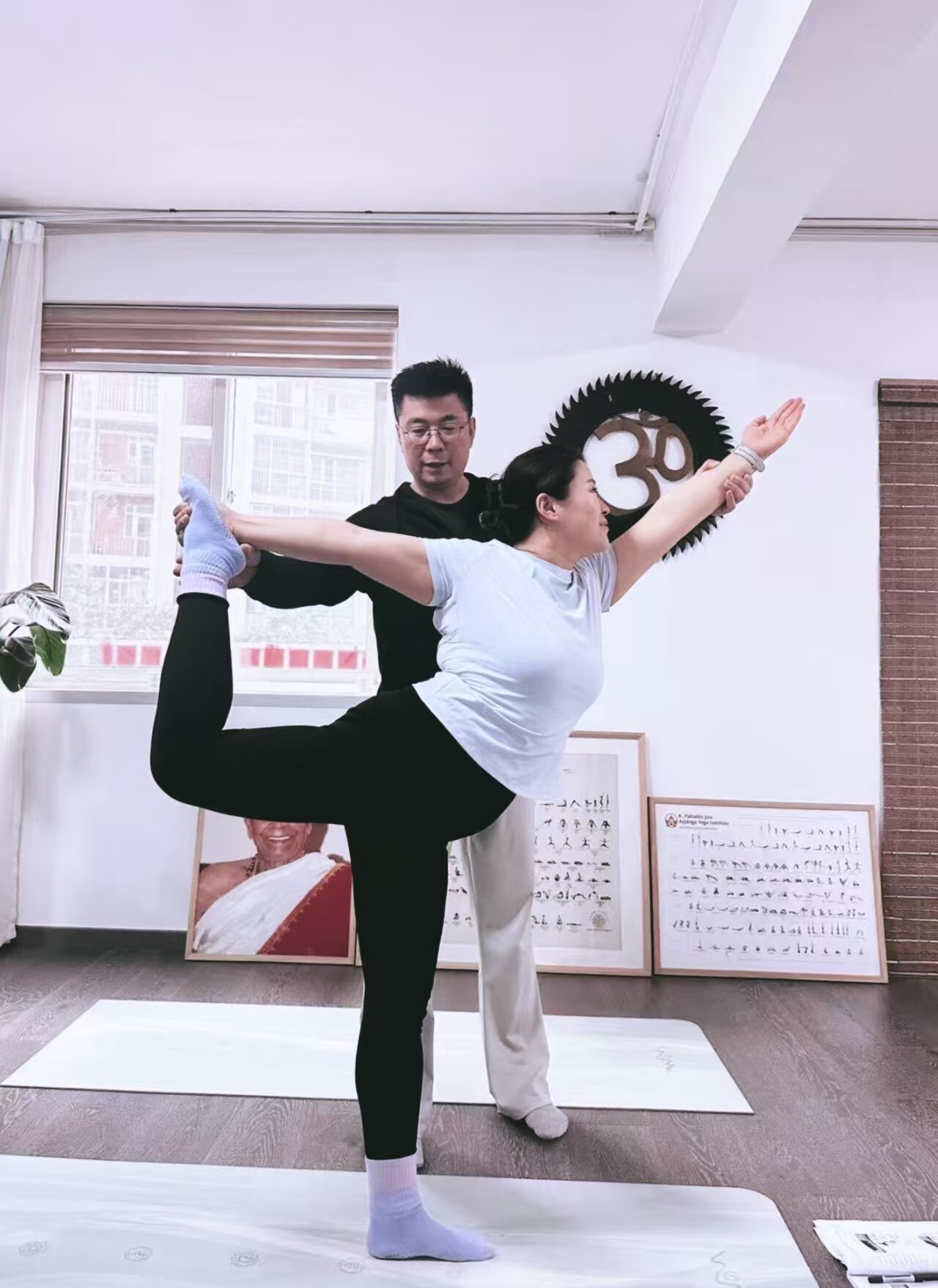
Natarajasana
The core philosophy is to find balance in motion, reveal renewal in destruction, and unite the dualities.
Honor Shiva as the Cosmic Dancer, the Adiyogi (First Yogi), and the embodiment of pure consciousness.
Dance the universe with your body.
Awaken in Balance
Reborn from ruin.
Reunite consciousness in duality.
1. Mythological Archetype: Shiva's Cosmic Dance (Tandava)
Cycle of Creation and Destruction
Shiva holds a drum in one hand (the sound of creation) and fire in the other (the power of destruction); his dance is the breath of the universe.
Old structures dissolve; new order emerges.
This reflects the yoga philosophy of non-attachment and mindful transformation.
Extinguish ignorance, stand in awakening
The "Demon of Ignorance" (Avidya) beneath your feet symbolizes transcendence beyond delusion and attachment.
Single-leg balance: representing the ability to stabilize a turbulent mind with awareness.
Unity of Eternity and the Present
The circular flame halo is the Wheel of Time; the dance exists both in eternity and in every moment.
Teach us to live in the present, free from the past and future.
II. Three Core Layers of Yoga Philosophy
Level 1: Shiva = Pure Consciousness (Purusha)
In the philosophy of number theory, Shiva represents pure consciousness (stillness, witness), while Shakti, the feminine energy, embodies matter and kinetic force (movement, manifestation).
The Dance King style embodies a dynamic balance between awareness and energy.:
- The grounded leg is still (Shiva).Rooted in the earth, steady and immovable.
- The lifted leg and extension are the movement (Shakti).: Extends upward, full of power
Purpose of Practice:
You are not your thoughts or body; you are the awareness behind them.
In the sway of asana, recognize the still witness.
Level 2: Destruction as Purification (Vinasaya)
Shiva's "destruction" dismantles the old self—fear, attachment, and identity chains—not as passive annihilation, but as clearing space for rebirth.
Like the withering of autumn and winter, gathering strength for spring.
Form Metaphor:
- Open the chest= Open up and let go of suppression
- Backbends & Stretches= Break limits, embrace a bigger version of yourself
Level 3: Freedom in Balance (Sthira-Sukha)
The classic Yoga text, the Bhagavad Gita, states: "Yoga is stability and ease (Sthira-Sukha)."
The Dance King style represents the pinnacle of dynamic balance:
Stable (Sthira):
- Rooted legs
- Engage your core
- Inner stability that remains unshaken by circumstances.
Comfort (Sukha):
- Spinal Extension
- Open shoulders and chest
- Relaxed yet alert, strong yet flexible.
Balance is freedom:
On the edge of imbalance, learn to let go of control and resistance; simply observe and adjust. Ultimately, transcend dualities (suffering/joy, gain/loss).
3. Asana Practice Guide
Prepare for the pose
Before attempting the full King Dancer Pose, practice these poses first:
- Mountain Pose (Tadasana): Establish a standing foundation
- Tree Pose (Vrksasana): Improve single-leg balance
- Warrior III (Virabhadrasana III): Establish front-to-back balance
- Bow Pose (Dhanurasana): Open your shoulders and chest
- Camel Pose (Ustrasana): Preparation for Deep Backbends
Standalone version 1: Wall practice
Ideal for: weaker balance, beginners
Practice Methods:
- Stand with your back against the wall, about one foot away from it.
- Shift your weight to the left foot and bend your right leg backward.
- Grasp the top of your right foot with your right hand and extend your left arm upward.
- Lightly lean your back against the wall to stay stable.
- Keep 3-5 breathing, switch sides
Key Points:
- Walls provide a sense of security, but don't rely on them completely.
- Focus on spinal extension
- Stare at a fixed point ahead.
Regression Version 2: Use a yoga strap
Ideal for: Stiff shoulders; unable to reach the feet
Practice Methods:
- Stand, shift weight to the left foot.
- Bend your right leg backward and loop the yoga strap around your right foot.
- Grasp both ends of the yoga strap with your hands.
- Slowly lift your right leg up.
- Keep 3-5 breathing, switch sides
Key Points:
- Adjustable-length yoga strap
- Do not force your legs to lift too high.
- Keep your chest open
Full Dance King Style
Ideal for: Possesses sufficient balance and flexibility
Practice Methods:
- Mountain Pose: Stand with feet together
- Shift your weight to the left foot and bend your right leg backward.
- Grasp the big toe of the right foot with the right hand from the inside.
- Extend your left hand upward, palm facing forward.
- Slowly lift your right leg upward and backward.
- Push the chest forward and arch the spine backward.
- Look toward the tip of your left index finger.
- Keep 5-8 breathing
- Slowly exit and switch sides for practice.
Key Points:
- Feet planted firmly on the ground, evenly distributed.
- Engage your core to protect your lower back.
- Keep your shoulders down; do not shrug.
- Open your chest; do not compress your lower back.
IV. Implications for Practitioners
1. Embrace Impermanence
Life is a cycle of creation, destruction, and rebirth.
Embrace change; stay true to yourself.
Like Shiva's dance, every ending is a new beginning.
2. Unity of Motion and Stillness
True stillness isn't silence; it's calm within motion and stability amidst busyness.
Cultivate inner stability through the dynamic balance of asanas.
3. Ablate Binary
Transcend the divisions of good and bad, strong and weak, internal and external.
Recognize that all things share a common origin and consciousness is one.
Experience non-dual wisdom in balance.
4. Dancing into Zen
The form is dynamic meditation.
Every stretch and balance is a journey back to your inner Shiva (awareness).
V. Common Errors and Corrections
Error 1: Shrugging
Issue: Shoulders tense and raised
Correction:
- Consciously lower your shoulders.
- Start with shoulder-opening poses
- Don't overdo backbends.
Error 2: Waist compression
Issue: Backward bending concentrates on the lower back, causing pain.
Correction:
- Focus on thoracic spine extension
- Engage your core to protect your lower back.
- Strengthen your back first
Error 3: Breath-holding
IssueHolding breath due to nervousness or exertion
Correction:
- Breathe deeply and evenly.
- If you can't breathe, the intensity is too high.
- Breathing guidance action
Error 4: Eyes wandering
Issue: Looking around affects balance
Correction:
- Gaze at a fixed point (Drishti)
- Focus on one point; do not move.
- Cultivate Inner Focus
VI. Contraindications and Precautions
Contraindicated Population
- Individuals with severe balance disorders
- For those with injuries to the waist, shoulders, or knees
- Pregnant women
- Patients with severe hypertension or heart disease
- Patients with vertigo
Practice Tips
- Fasted workoutWait at least 2-3 hours after eating.
- Warm up thoroughly: especially the shoulders, hips, and spine
- step by step: Starting from the reduced version
- Listen to your body: Pain is a signal to stop
VII. Supplementary Practice Sequence
Daily practice tips
Monday: Balance Basics
- Mountain Pose 2 minutes
- Tree Pose: 3 times per side
- Warrior III 3 times per side
Wednesday: Shoulder-opening exercise
- Cow Face Arms 2 reps per side
- Eagle Arms 2 reps per side
- Bow 3 times
FridayIntegration Practice
- Complete warm-up
- Modified Dancer Pose or Full Dancer Pose
- Child's Pose
Assistant Tools
- wall: provides security and support
- Yoga Strap: Helps you grab your feet
- Yoga Block: Place underfoot to add height
- Chair: Hold the chair back for balance
8. Meditation and Reflection
Meditate before practice
Close your eyes and take 3 deep breaths.
Imagine yourself as Shiva, the cosmic dancer.
Amid the halo of time's flames,
Dancing between creation and destruction.
Every breath is the universe's pulse.
Post-Exercise Reflection
After completing the exercise, sit quietly for a moment and ask yourself:
- What have I felt in balance?
- When did I lose awareness?
- How can you bring this balance into your daily life?
Conclusion
Dance King Style: Dancing the universe with your body.
Awaken in Balance
Reborn from ruin.
Reunite consciousness in duality.
May you practice with the intensity of a Dance King,
Find the Shiva within you—
That eternal Witness,
That tranquil observer,
The self that remains unchanged amidst the flux.
Namaste